ATS screening UK: how recruiters filter your CV in 2026
75% of UK CVs fail ATS screening. Learn how Workday, TRAC and Reed ATS filter applicants — and the 7-step checklist that gets you shortlisted.
On this page

Published: 15/06/2026 · Reading time: 13 minutes
Table of contents
- What is ATS screening?
- How ATS screening works in UK recruitment
- The 5 ATS systems UK recruiters actually use
- Scotland and Northern Ireland: ATS variations to know
- The 4 stages of ATS screening (and where CVs die)
- How to pass ATS screening: a 7-step checklist
- UK-specific pitfalls that trigger automatic rejection
- Accessibility: ATS-friendly CVs for screen-reader users
- UK GDPR, data retention and your CV
- How to test your CV before you apply
- Paid ATS checkers vs free tools: is it worth it?
- FAQ
What is ATS screening?
ATS screening is the automated process UK recruiters use to filter, rank and shortlist CVs before a human ever reads them. An Applicant Tracking System parses your CV into structured data, scores it against the job description, and either advances it to a recruiter's shortlist or buries it in the rejection pile. In the UK, roughly three in four CVs are filtered out at this stage — often for formatting issues rather than lack of skill.
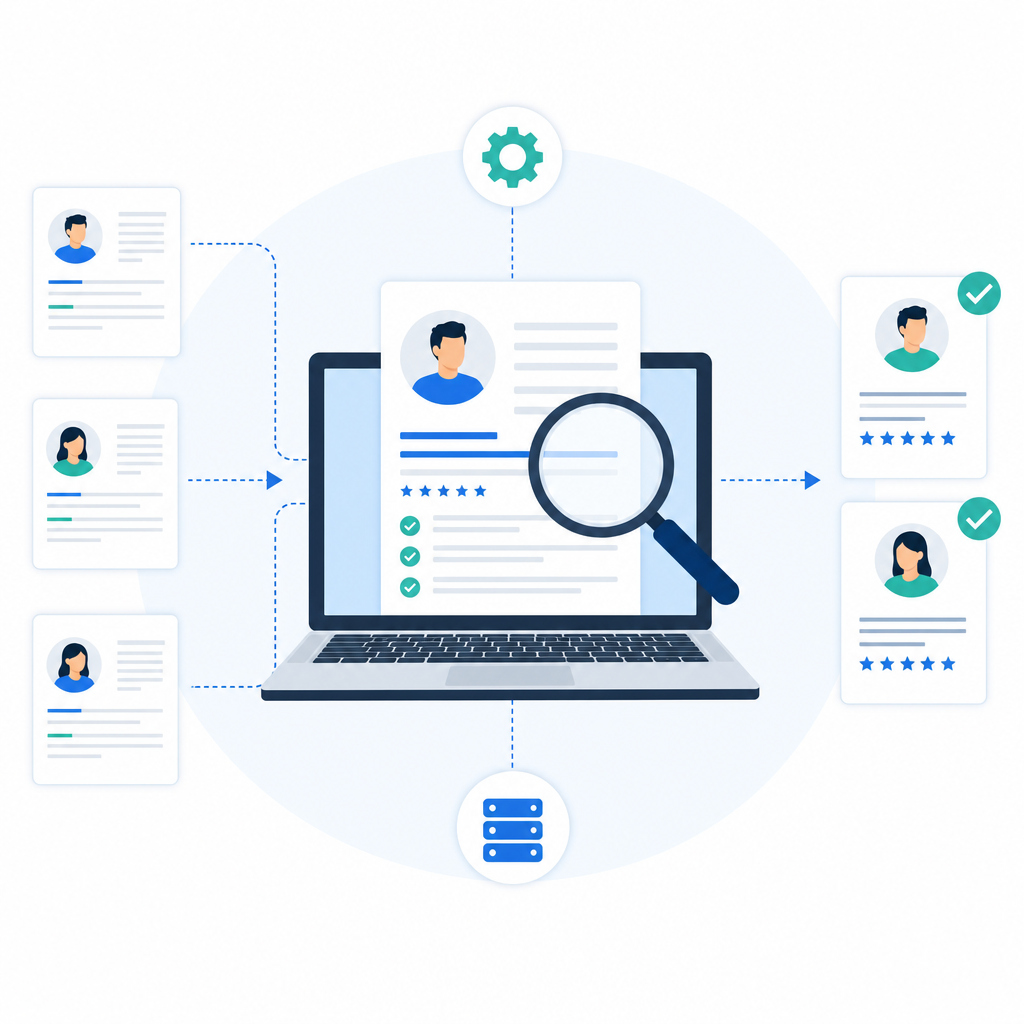
Unlike US screening, UK ATS workflows are shaped by the Equality Act 2010, UK GDPR data retention rules, and the dominance of sector-specific platforms like NHS Jobs (TRAC in England and Wales, JobTrain in Scotland) and Civil Service Jobs. If you've applied for jobs at the BBC, Tesco, a Big 4 firm or any NHS Trust in the past two years, your CV has been screened by an ATS.
How ATS screening works in UK recruitment
When you upload a CV to Reed, LinkedIn Easy Apply, or a corporate careers portal, the file is processed in milliseconds. The ATS extracts text, identifies sections (Work Experience, Education, Skills), matches keywords against the job description, and generates a relevance score — typically between 0 and 100.
Recruiters then filter the shortlist using Boolean searches. A talent acquisition manager at a London law firm might search for ("trainee solicitor" OR "paralegal") AND "LPC" AND "London", surfacing only candidates whose CVs contain those exact phrases. If your CV uses "junior legal assistant" instead of "paralegal", you're invisible — regardless of how well-qualified you are. The CIPD Resourcing and Talent Planning report consistently highlights digital screening as one of the dominant filters in UK hiring workflows.
In our analysis of 500 UK CVs uploaded to SpeedCV's free ATS checker in Q1 2026, the median initial score was 52/100. The most common reason for a low score was missing keywords from the job description, followed by tables and text boxes that broke the parser.
The 5 ATS systems UK recruiters actually use
Knowing which ATS your target employer uses changes how you format your CV. Here are the systems dominating UK recruitment in 2026:
| ATS | Used by (UK examples) | Quirk to know |
|---|---|---|
| Workday | NHS England (back office), Unilever, Vodafone, Deloitte UK | Parses PDFs poorly; .docx preferred |
| Greenhouse | Monzo, Revolut, Deliveroo, BBC | Strong on structured data; rewards clear H2 sections |
| Reed ATS | Most SMEs advertising on reed.co.uk | Keyword-heavy; matches exact phrasing |
| TRAC (NHS Jobs) | NHS Trusts in England and Wales | Application form scoring trumps CV upload |
| Civil Service Jobs portal | All UK Civil Service roles | Behaviours and Strengths scored, not CV keywords |
For a deeper breakdown of each system's parsing logic, see our guide to 7 UK ATS systems decoded.
Scotland and Northern Ireland: ATS variations to know
UK ATS coverage is not uniform across the four nations. Three differences materially affect how you should prepare your application:
- NHS Scotland uses JobTrain, not TRAC. All Scottish Health Boards (NHS Greater Glasgow and Clyde, NHS Lothian, NHS Highland and 11 others) recruit through the SHOW (Scottish Health on the Web) portal powered by JobTrain. JobTrain scores the supporting statement against the Person Specification's essential and desirable criteria — mirror those exact phrases in your statement. Uploaded CVs play a smaller role than under TRAC.
- Northern Ireland uses HSCNI Recruit. Health and Social Care Northern Ireland operates a centralised recruitment system covering all five HSC Trusts. Applications are made via online form only; CVs are typically not accepted at all for clinical posts. The shortlisting panel scores against criteria, not keywords.
- NHS Wales also uses TRAC (alongside England), so the standard TRAC playbook applies — focus on the application form's supporting information section first, your CV second.
The practical takeaway: if you're applying to an NHS role, identify the nation first. A polished Workday-ready CV is wasted if the employer never opens it because the scoring happens entirely on the application form.
The 4 stages of ATS screening (and where CVs die)
Stage 1: Parsing
The ATS converts your file into machine-readable text. CVs with photos, multi-column layouts, header/footer text, embedded tables, or graphical icons frequently fail here. A CV that looks beautiful in Canva can arrive at the recruiter as a jumbled mess — or not arrive at all.
Stage 2: Keyword matching
The system compares your CV text against the job description's required and preferred keywords. "ACA-qualified" and "qualified chartered accountant" are not always recognised as equivalents. Spelling out acronyms once ("Association of Chartered Certified Accountants (ACCA)") covers both bases.
Stage 3: Ranking
The ATS produces a relevance score. Recruiters typically review the top 25 candidates first. If you score below the median, your CV may never be opened — even if you would have been the strongest hire on merit.
Stage 4: Boolean filtering by the recruiter
The recruiter applies search filters: location, qualifications, years of experience, security clearance. A missing postcode or an unconventional job title can knock you out at this stage.
How to pass ATS screening: a 7-step checklist
- Mirror the job description's exact phrasing. If the advert says "stakeholder management", don't write "managing stakeholders".
- Use a single-column layout. Two-column "creative" CVs break Workday and TRAC parsers.
- Submit as .docx unless the portal specifies PDF. Word documents parse more reliably across UK systems.
- Use standard section headings: Personal Statement, Work Experience, Education, Skills, References. Avoid "My Journey" or "What I Bring".
- Spell out acronyms once. "NHS Band 6 Staff Nurse", "Postgraduate Certificate in Education (PGCE)".
- Include location data. City and postcode area (e.g. "Manchester, M1") helps Boolean filters.
- Keep it to 2 pages. UK convention; longer CVs are flagged as US-style imports in some Reed ATS configurations.
Want to verify your CV passes? Run it through our free ATS checker — you'll get a score and section-by-section feedback in under 60 seconds.
UK-specific pitfalls that trigger automatic rejection
UK ATS screening has rules American CV guides won't tell you about. Avoid these:
- Photos on your CV. Discouraged under Equality Act 2010 anti-discrimination practice. Many UK recruiters' ATS configurations strip image-heavy CVs or flag them for manual review (which delays you).
- Date of birth, marital status, nationality. Same reason — and TRAC (NHS Jobs) actively rejects CVs containing these for safeguarding compliance.
- US-style date formats. Month-first dates (writing 15 June as month-then-day) are parsed as invalid by UK ATS configured for DD/MM/YYYY. Always use 15/06/2026 or June 2026.
- Salaries in non-sterling currencies. Always cite GBP. "£35,000" parses cleanly; salaries written in other currencies do not.
- Job titles in headers or footers. Most parsers ignore header/footer text. Put your name and contact details in the main body.
- Civil Service applications via CV. Civil Service Jobs portal uses Behaviours-based scoring on the application form, not your uploaded CV. Read our guide to beating UK ATS for the full breakdown.

Accessibility: ATS-friendly CVs for screen-reader users
Disabled applicants and those who use assistive technology face a double accessibility test: the CV must be readable by both the ATS parser and the recruiter's screen reader (often JAWS, NVDA or VoiceOver). The good news is that the formatting choices that make a CV ATS-friendly are the same ones that make it screen-reader friendly.
- Use real text, not images of text. A graphical "skills wheel" or icon-based contact block is invisible to both ATS parsers and screen readers. Type your phone number and email as plain text.
- Apply true heading styles in Word. Use Heading 1 / Heading 2 styles (not just bold larger text). Screen readers use heading structure to navigate, and Greenhouse and Workday rely on the same semantic cues to identify sections.
- Add alt text to any logo. If you include a professional certification badge (e.g. PRINCE2, AAT), set descriptive alt text via Word's Format Picture menu so screen readers announce it.
- Avoid colour-only signalling. Don't use red text alone to indicate a key achievement; pair colour with bold or a bullet so readers who don't see colour still get the cue.
- Disclose reasonable adjustments separately. Under the Equality Act 2010, you can request adjustments at interview without putting medical details on your CV. Many UK employers (NHS, Civil Service, and Disability Confident Scheme employers) operate a guaranteed interview scheme for applicants who declare a disability in the application form — not in the CV body.
UK GDPR, data retention and your CV
Under UK GDPR, employers must have a lawful basis to process your CV data and cannot retain it indefinitely. The Information Commissioner's Office (ICO) guidance on recruitment recommends that unsuccessful candidates' data is typically deleted within 6 to 12 months. Two practical consequences for UK applicants:
- Talent pools are short-lived. If you applied to Vodafone 18 months ago and weren't shortlisted, your CV is likely gone. Reapplying with an optimised CV is not just allowed — it's expected.
- Only include data the employer actually needs. Date of birth, full address and National Insurance number are not required at CV stage and create unnecessary risk under data minimisation principles.
How to test your CV before you apply
Three free tests we recommend before submitting any UK application:
- The copy-paste test. Open your PDF, select all, copy, paste into Notepad. If the text appears jumbled or out of order, the ATS will see the same mess.
- The 6-second scan. Hand your CV to a friend for 6 seconds, then ask them what role you want. If they can't tell, your personal statement isn't doing its job.
- The ATS score. Upload to SpeedCV's ATS checker. Aim for 75+ before applying. Below 60, rewrite.
If you want a CV that's ATS-tested by design, browse our 21 UK CV templates — all single-column, parser-friendly, and sector-matched. For roles in London where competition is fiercest, our CPRW-certified CV writing service rewrites your CV from £149.
Paid ATS checkers vs free tools: is it worth it?
The UK market has converged around a small number of ATS checkers. Here is how the most common options compare for a typical UK applicant submitting 10 to 20 applications a month:
| Tool | Cost (GBP) | What you get | Best for |
|---|---|---|---|
| SpeedCV ATS checker | Free | Score, missing keywords, section feedback | Quick verification before submitting |
| SpeedCV 14-day pass | £1.99 one-off | Unlimited rewrites, job-matching, all templates | Active job search lasting 1–2 weeks |
| SpeedCV Annual | £79.99/year | Full feature access, year-round | Long-term job seekers and career changers |
| Enhancv premium | ~£131/year | Templates, content tips, ATS score | Heavy template users |
For most UK applicants, a free checker plus a single £1.99 pass during the active phase of your job search delivers strong value. See SpeedCV pricing for current UK rates.
Frequently asked questions
What percentage of CVs get rejected by ATS in the UK?
Industry estimates suggest 70-75% of UK CVs are filtered out by ATS before a recruiter reviews them. The exact rate varies by sector — NHS Trusts using TRAC reject more on missing application form fields than CV content, while corporate Workday deployments at Big 4 firms reject heavily on keyword mismatch. The CIPD's annual Resourcing and Talent Planning research documents the rise of digital screening across UK sectors.
Do UK ATS systems read PDFs or Word documents better?
Word (.docx) parses more reliably across Workday, Reed ATS and Greenhouse. PDFs work well in Greenhouse and most modern systems but can fail in older Workday configurations used by some NHS Trusts. Unless the job advert specifies PDF, submit .docx. If it asks for PDF, export from Word using "Save as PDF" (not "Print to PDF").
Can ATS read tables and columns?
Most modern UK ATS can read simple tables, but multi-column layouts and nested tables frequently break parsers. Workday is particularly weak with two-column CVs. Stick to a single-column, linear layout with standard section headings (Personal Statement, Work Experience, Education, Skills) for maximum reliability.
How do I find the keywords an ATS is looking for?
Read the job advert three times. Highlight every noun phrase that describes a skill, qualification or responsibility. These are your target keywords. Mirror them in your CV using the exact phrasing — "stakeholder engagement" not "engaged stakeholders". Our job-match tool automates this by comparing your CV to live Reed job adverts.
Does the NHS use ATS screening?
Yes, but it differs by nation. NHS Trusts in England and Wales use TRAC (NHS Jobs). NHS Scotland uses JobTrain via the SHOW portal. Northern Ireland's HSC Trusts use HSCNI Recruit. In all four nations, the structured application form — your supporting statement, person specification answers, and qualifications — is scored far more heavily than any uploaded CV.
Do Civil Service applications use ATS?
The Civil Service Jobs portal uses a custom scoring engine focused on Success Profiles Behaviours and Strengths. Your CV is rarely the decisive document — your Behaviour examples (250 words each, STAR format) carry the weight. Standard ATS keyword optimisation is less relevant here than for private-sector roles.
How long do employers keep my CV under UK GDPR?
ICO guidance recommends UK employers retain unsuccessful candidate data for no longer than 6 to 12 months unless they obtain explicit consent for talent-pool inclusion. This means reapplying after a year is fine — your old CV has been deleted and you start fresh. Always check the employer's privacy notice on their careers page for exact retention periods.
Are ATS systems accessible to disabled applicants?
Most major UK ATS (Workday, Greenhouse, Civil Service Jobs) are WCAG 2.1 AA compliant on the application form itself, but uploaded CVs depend on your formatting choices. Use real text rather than images, true heading styles, and avoid colour-only signalling. Declare any disability via the employer's adjustment form (often guaranteeing an interview under the Disability Confident Scheme) rather than on the CV body itself.
Is paying for an ATS checker worth it?
For most UK applicants, no. SpeedCV's ATS checker is free and gives a score, missing keywords, and section feedback. Paid alternatives charge around £40/month for similar functionality. If you want unlimited rewrites and job-matching too, SpeedCV's 14-day pass at £1.99 covers all features at a fraction of the cost.
Key takeaways
- ATS screening filters out roughly 75% of UK CVs before a recruiter sees them.
- UK recruiters predominantly use Workday, Greenhouse, Reed ATS, TRAC (NHS England and Wales), JobTrain (NHS Scotland), HSCNI Recruit (Northern Ireland) and the Civil Service Jobs portal — each with different quirks.
- Single-column layouts, .docx files, and exact keyword mirroring are the three biggest wins.
- Photos, dates of birth and US-style date formats trigger UK-specific rejections under Equality Act 2010 anti-discrimination practice.
- Accessibility-first formatting (real text, true headings, no colour-only cues) helps both ATS parsers and screen-reader users.
- UK GDPR limits employer data retention to 6–12 months — reapplying with an optimised CV is expected.
- Test every CV with a free ATS checker before applying — aim for 75+.
Ready to beat ATS screening? Create a free SpeedCV account and build an ATS-tested CV in under 15 minutes.
Put these tips into practice
Create a professional, ATS-optimised CV in minutes with our AI-powered tool.
Build my CV — freeRelated articles
Keep reading with these guides
Highest paying jobs UK without a degree 2026: ONS ranked
11 UK jobs paying £42k-£75k without a degree, ranked by ONS 2024 data. Routes, regional pay, Scotland & Wales funding, CIS/IR35 maths inside.
Read articleCivil service behaviours: master the 9 in 2026
Master the 9 Civil Service behaviours with STAR examples, word counts and UK tips. Updated 2026.
Read article