Applicant tracking systems UK: how to beat ATS in 2026
75% of UK employers screen CVs with ATS. Our 2026 guide reveals the 7 formatting rules to beat Workday, Greenhouse and Bullhorn — with sector examples.
On this page

Around 75% of large UK employers now screen CVs through applicant tracking systems before a human ever reads them (CIPD Resourcing and Talent Planning Survey). If your CV is not formatted for these systems, it can be filtered out within seconds — regardless of how qualified you are. This guide breaks down the applicant tracking systems UK recruiters actually use, how each one parses your CV, and the specific formatting choices that move you from the rejection pile to the shortlist.
We have analysed CVs uploaded to our free ATS checker and cross-referenced the parsing behaviour of the four dominant UK systems: Workday, Greenhouse, Bullhorn and SmartRecruiters. The patterns are consistent — and most rejections are entirely avoidable.
Table of contents
- What is an applicant tracking system?
- The UK ATS landscape: who uses what
- How ATS software reads your CV
- 7 formatting rules to pass UK ATS in 2026
- Keywords: matching the UK job advert
- LinkedIn Easy Apply: how it interacts with UK ATSs
- Cover letters, GDPR and ATS data retention
- Disability disclosure, Access to Work and ATSs
- Sector examples: NHS, Civil Service, retail and tech
- 7 mistakes that get UK CVs auto-rejected
- Frequently asked questions
What is an applicant tracking system?
An applicant tracking system (ATS) is recruitment software that collects, parses and ranks job applications. UK employers use ATS platforms to manage high application volumes, extract structured data from CVs, and filter candidates against job criteria before a recruiter reviews any shortlist. Common UK systems include Workday, Greenhouse, Bullhorn and SmartRecruiters.
In practice, when you upload your CV to a UK job portal, the ATS converts your document into a structured database record. It identifies your contact details, work history, education and skills, then scores how well that record matches the job advert. Recruiters typically review only the top-ranked applications.
The UK ATS landscape: who uses what
UK recruitment is dominated by four enterprise systems plus the in-house portals of major job boards. Knowing which ATS sits behind the role you are applying for changes nothing about your CV — but it explains why formatting matters more in some sectors than others.
| ATS | UK employers using it | Strict on formatting? |
|---|---|---|
| Workday | NHS Trusts, Tesco, Sainsbury's, Aviva, HSBC, Big 4 consultancies | Very strict — parses headings literally |
| Greenhouse | UK tech scale-ups, Monzo, Deliveroo, Trainline | Moderate — better with modern CV layouts |
| Bullhorn | UK recruitment agencies (Hays, Michael Page, Reed Specialist) | Strict — agencies bulk-parse CVs |
| SmartRecruiters | Marks & Spencer, John Lewis, McDonald's UK | Moderate |
| Reed ATS | Reed.co.uk job applications | Lenient — but ranks on keyword match |
| NHS Jobs (TRAC) | NHS Trusts (Bands 2–9) | Form-based — no CV upload |
| Civil Service Jobs | Grade 7, SCS, Fast Stream | Form-based — Behaviours scored separately |
Two important UK-specific points. First, the NHS Jobs portal and Civil Service Jobs portal are not traditional ATSs — they ask you to complete structured forms rather than upload a CV. The CV you prepare still matters because it feeds your supporting statement, but the screening logic is different. Second, Bullhorn is everywhere in agency recruitment — if you are working with Hays or Michael Page, your CV is being parsed multiple times.
How ATS software reads your CV
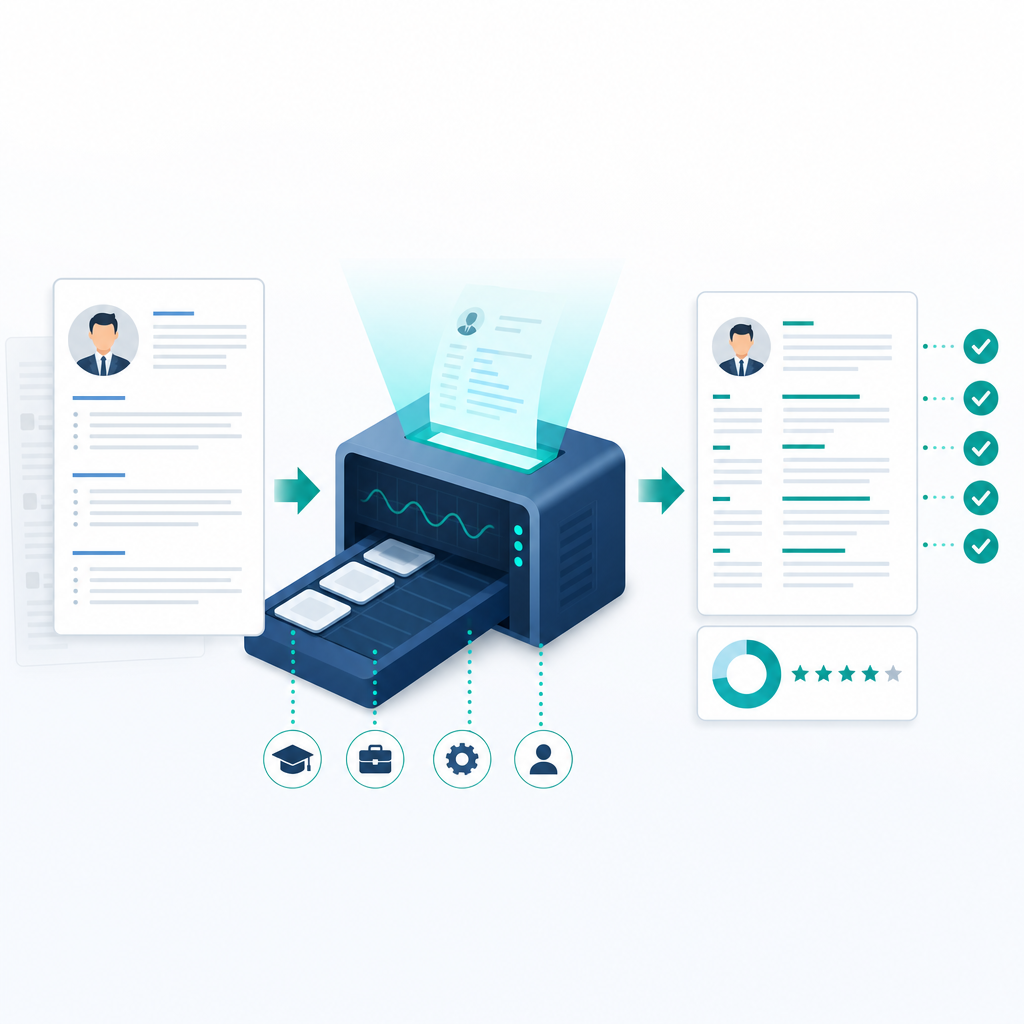
An ATS does not read your CV the way a recruiter does. It runs a parsing algorithm that scans for predictable patterns — section headings, dates, job titles, employer names — and tries to slot each piece of text into the correct database field. When parsing fails, your work history might end up in the "Education" column, your skills might be missed entirely, or your application might be flagged as incomplete.
The parsing sequence
- Text extraction — the ATS strips out formatting and pulls raw text. PDFs created from images (scans) fail at this stage.
- Section detection — it looks for standard headings: "Work experience", "Education", "Skills". Creative headings ("My journey") often confuse the parser.
- Entity recognition — it identifies dates (DD/MM/YYYY is safe), job titles, company names and qualifications.
- Keyword matching — it scores your CV against the job advert's required and desired skills.
- Ranking — recruiters see candidates sorted by match score.
Why most CVs lose points here
Common failure modes we see in our ATS checker: tables used for layout (the parser reads them column-by-column, jumbling your job history), text boxes (often invisible to ATS), graphic icons replacing section headings, dates written as "Jan 2023 – Present" instead of a consistent numeric format, and photos (still routinely added to UK CVs despite Equality Act 2010 risks).
7 formatting rules to pass UK ATS in 2026
- Use a single-column layout. Two-column "creative" templates from sites like Canva look striking but parse badly. Stick to a clean one-column structure.
- Use standard section headings. "Personal statement", "Work experience", "Education", "Skills", "References". Plain, sentence case, no decorations.
- Submit as .docx or text-based PDF. Never submit a scanned PDF or a CV exported as an image. If in doubt, .docx is the safest UK format.
- Use a clean sans-serif font. Arial, Calibri or Helvetica at 10–11pt. Avoid decorative fonts.
- Format dates consistently. DD/MM/YYYY or MM/YYYY throughout. Mixing "2023" with "03/2023" confuses parsers.
- Spell out acronyms once. "Search Engine Optimisation (SEO)" on first mention. The ATS may search for either term.
- No photo, no date of birth, no marital status. Under UK Equality Act 2010 conventions, including these fields creates unnecessary discrimination risk — and UK recruiters are routinely trained to anonymise CVs that contain them before forwarding to hiring managers.
Our 21 UK CV templates are all single-column, ATS-tested layouts. If you would rather have a professional rewrite your CV by hand, our London CV writing service uses CPRW-certified writers familiar with all four major UK ATSs.
Keywords: matching the UK job advert
Keyword matching is where the ranking happens. The ATS extracts skills, qualifications and tools from the job advert, then counts how many appear in your CV. A high match score puts you in the recruiter's top 25 candidates — a low score buries you on page 12.
How to identify the right keywords
Paste the job advert into a word frequency tool, or use our CV-to-job matching tool, which uses Voyage AI to compare your CV against live UK Reed listings. Look for:
- Hard skills — software, tools, certifications (e.g. "Salesforce", "PRINCE2", "ACCA")
- Job title variations — if the advert says "Marketing Executive", include that phrase, not just "Marketer"
- UK qualifications — "NVQ Level 3", "BTEC", "GCSE Grade 5/C or above"
- Methodologies — "Agile", "STAR", "competency-based"
Where to place keywords
Sprinkle keywords across your personal statement, work experience bullets and skills section. Avoid keyword stuffing — modern ATSs and recruiters both penalise CVs that read like a thesaurus. A natural rule: each key skill should appear two to three times across the CV, ideally in context ("Led Agile sprint planning for a team of six developers" beats a bare "Agile" in a skills list).
LinkedIn Easy Apply: how it interacts with UK ATSs
LinkedIn Easy Apply is now the default submission route for a large share of UK job listings — but it is not itself an ATS. Behind the scenes, Easy Apply pushes your data into the employer's existing system, most often Workday, Greenhouse or SmartRecruiters. Two things happen that catch UK applicants out.
First, the CV LinkedIn submits is the one you last uploaded to your profile under Settings > Job seeking preferences, not a tailored version. If you have not refreshed that file in six months, an outdated CV is being parsed every time. Update it before any Easy Apply session.
Second, Easy Apply harvests your LinkedIn profile data (headline, current role, skills) and merges it into the recruiter's ATS record. If your LinkedIn headline reads "Open to work" but your CV personal statement targets a specific job title, the two records conflict — and the ATS scores against the weaker of the two. Mirror your CV's target job title in your LinkedIn headline before applying.
For mid-senior UK roles where the employer's careers page asks the same questions as Easy Apply, applying directly via the careers page tends to produce a cleaner ATS record. Easy Apply remains the right channel for volume applications and graduate schemes.
Cover letters, GDPR and ATS data retention
Two questions come up repeatedly in our user feedback: do UK ATSs parse cover letters, and what happens to my data after I apply?
Do UK ATSs parse cover letters?
Yes, but inconsistently. Workday and Greenhouse extract text from uploaded cover letters and add it to the candidate record, where keywords can boost match scores. Bullhorn often treats the cover letter as a single text field attached to the CV. Reed.co.uk and TotalJobs typically display the cover letter to the recruiter without parsing it for keyword matching. Practical implication: write your cover letter for the recruiter, not the parser — but do include the two or three priority keywords from the job advert.
How long does an ATS keep your data?
Under UK GDPR, employers must define a lawful basis for retaining unsuccessful applicants' data. Most UK employers retain CVs for 6–12 months for future opportunities, then delete or anonymise the record. You have a right to erasure: if you do not want a particular employer to keep your CV on file, email their HR or data protection officer and request deletion. Reputable ATSs (Workday, Greenhouse) provide a self-service deletion link on application receipts.
Disability disclosure, Access to Work and ATSs
UK employers signed up to the Disability Confident scheme commit to interviewing every disabled applicant who meets the minimum criteria for a role. Many UK ATSs (Workday, SmartRecruiters and Civil Service Jobs in particular) include an explicit "Disability Confident — guaranteed interview" tick-box during application. Ticking it routes your application down a separate pipeline that bypasses the standard keyword-ranking filter.
You are not legally required to disclose a disability at application stage — disclosure is a personal choice. If you do tick the box, the ATS does not share that information with hiring managers reviewing the CV; it is held by HR and used only to confirm guaranteed-interview eligibility under the scheme. For applicants who would benefit from reasonable adjustments at interview (extra time, a quiet room, written questions in advance), disclosure is the route that triggers them.
Access to Work is a separate gov.uk scheme that funds workplace support once you are in post (specialist equipment, BSL interpreters, taxi fares). It does not interact with the ATS itself — you apply for Access to Work after accepting a job offer, not during the application.
Sector examples: NHS, Civil Service, retail and tech
NHS Band 5 nursing applications
NHS Jobs uses TRAC, a form-based portal — but your supporting information field is scored against the person specification. Mirror the language exactly: if the spec says "NMC registration", write "NMC registration" (not "nursing council registration"). Include all six NHS values (compassion, respect, dignity, learning, working together, quality) where you can evidence them with examples.
Civil Service Fast Stream
The Civil Service screens applicants on the nine Civil Service Behaviours, not keyword density. Each Behaviour answer (250 words) is read by a human assessor against a published framework. Your CV is barely used at the initial sift — your STAR-format Behaviour responses do the heavy lifting.
Retail Christmas temp at Tesco or M&S
SmartRecruiters (M&S) and Workday (Tesco) both run heavy keyword filters during peak hiring. Match the job advert's exact wording for shift availability, right-to-work status and customer service experience. "Stock replenishment", "till operation" and "customer-facing" are common required terms.
Big 4 graduate scheme
Deloitte, PwC, EY and KPMG use Workday for their UK graduate intake. The CV upload is one input among many — situational judgement tests and game-based assessments matter more. But Workday still parses your CV for university, degree class (2:1 minimum at most firms), UCAS points and any relevant work experience. If you are weighing salary across sectors before applying, our guide to the top paid professions in the UK 2026 uses ONS data to benchmark graduate scheme outcomes.
7 mistakes that get UK CVs auto-rejected
- Using a US resume template. One-page "resume" layouts with photos and street addresses fail UK conventions and confuse UK ATSs.
- Putting contact details in the header/footer. Many ATSs ignore header and footer content entirely. Put your name, email and phone in the main body.
- Submitting as a Pages, ODT or scanned PDF. Workday and Bullhorn fail to parse these reliably. Use .docx or a text-based PDF.
- Tables and text boxes for layout. They look clean visually but break parsing. Use plain headings and bullets instead.
- Inconsistent dates. "Jan 2022 to date" mixed with "2020-2021" makes work history extraction unreliable.
- Buzzword-stuffed personal statements. "Dynamic, results-driven team player" adds zero keyword value and signals a generic application.
- No measurable achievements. ATSs rank for keywords, but the human recruiter on the other side ranks for evidence. "Increased sales by 18% over six months" outperforms "Responsible for sales".
You can test any UK CV against these criteria for free with our ATS checker — it returns a score plus specific fixes within 30 seconds. If you want unlimited rewrites and AI-suggested improvements per job application, our 14-day pass costs £1.99.
Frequently asked questions
Do UK companies really use applicant tracking systems?
Yes — CIPD research shows the majority of large UK employers use ATS software, and almost every FTSE 100 company runs at least one (most commonly Workday). SMEs increasingly use ATSs too, either directly or via recruitment agencies on Bullhorn. If you are applying through Reed, TotalJobs, LinkedIn or a major employer's careers page, your CV is being parsed.
What is the best CV format for an ATS in the UK?
A single-column, reverse-chronological CV in .docx or text-based PDF format. Use standard section headings (Personal statement, Work experience, Education, Skills), a clean sans-serif font at 10–11pt, and consistent DD/MM/YYYY date formatting. No photo, no graphics, no tables for layout. Aim for two pages maximum — the UK standard.
Does LinkedIn Easy Apply send my CV through an ATS?
Yes. Easy Apply pushes your LinkedIn profile data and the CV stored under your job-seeking preferences into the employer's underlying ATS (typically Workday, Greenhouse or SmartRecruiters). Refresh the CV on your LinkedIn profile before any Easy Apply session, and align your LinkedIn headline with the target job title to avoid a conflicting parsed record.
Should I include keywords from the job advert?
Yes — keyword matching is how ATSs rank applications. Identify hard skills, software, qualifications and methodologies in the job advert, and weave them naturally through your personal statement, work experience and skills section. Avoid stuffing; aim for two to three contextual mentions of each priority keyword.
Does the NHS use an ATS for job applications?
NHS Trusts use the NHS Jobs portal (TRAC), which is form-based rather than a traditional ATS — you complete structured fields rather than upload a CV. Your supporting information section is scored against the person specification. Some NHS Trusts have also moved to Workday for senior medical and management roles. Either way, mirroring the person specification's exact language is essential.
Can an ATS read a PDF CV?
Yes, if the PDF was exported directly from a word processor (text-based PDF). No, if it is a scanned image or a PDF saved from a design tool that flattens text to image. When in doubt, submit a .docx file — every major UK ATS handles .docx reliably.
How do I know if my CV passed the ATS?
You usually do not — most UK employers do not disclose ATS scores. The signals are indirect: rejection within 24–48 hours often means an ATS filter; rejection after a week typically means a human reviewed and declined. To self-test, use a free ATS checker that simulates the parsing logic of Workday and Greenhouse.
Do I need to pay for ATS-optimised CV templates?
No. Plenty of ATS-friendly templates are free — including our entry-level UK templates. What you typically pay for is built-in AI tailoring per job application, unlimited downloads, and premium designs. SpeedCV's £79.99 annual plan is currently the cheapest among UK competitors (vs Enhancv at around £131.88/year and Resume.io at around £273/year).
Key takeaway
UK applicant tracking systems are not gatekeepers designed to block you — they are filters designed to surface the most relevant applications quickly. The candidates who get shortlisted are not necessarily the most qualified; they are the ones whose CVs parse cleanly, mirror the job advert's language, and present achievements in a structure the ATS can read. Get those three things right and you will be in the top 25 candidates the recruiter actually sees.
Create a free SpeedCV account to build an ATS-optimised UK CV in minutes, or run your existing CV through our free ATS checker first.
Put these tips into practice
Create a professional, ATS-optimised CV in minutes with our AI-powered tool.
Build my CV — freeRelated articles
Keep reading with these guides
Cover letter sample: 5 UK examples that won interviews
5 UK cover letter samples — NHS, Civil Service, retail, hospitality, Big 4 finance. ATS-tested, free to copy (2026).
Read articleCV writing London: 2026 costs, top services & insider tips
CV writing London costs £75–£600 in 2026. Compare CPRW-certified writers, ATS tactics for Workday/Greenhouse and insider tips for City, NHS & Civil Service.
Read article