HGV jobs UK 2026: Class 1, Class 2 & no-experience routes
HGV jobs UK 2026: realistic salaries, licence costs, top employers, agency vs PAYE, HMRC overnight allowance & ATS-ready CV tips. No-experience routes too.
On this page

HGV jobs UK 2026 are still in genuine demand. Following the well-documented HGV driver shortage that peaked in 2021, the Department for Transport and the Logistics UK Skills and Employment Report confirm that vacancies remain elevated across cold-chain, construction, fuel and supermarket distribution. If you're searching for heavy rigid jobs — what the industry now calls Category C (Class 2) and Category C+E (Class 1) work — this guide walks you through licences, training costs, realistic salaries, the best employers, agency-versus-PAYE pay, HMRC overnight allowances, and exactly how to write a CV that gets past Workday and Reed ATS filters.
Table of contents
- What HGV jobs actually involve in 2026
- Class 1 vs Class 2: licences, pay and lifestyle
- How to get your HGV licence (costs and timeline)
- HGV salaries UK 2026 by sector and region
- Agency vs PAYE: umbrella companies and IR35
- HMRC overnight subsistence and HGV-specific tax allowances
- Brexit and EU cabotage: international Class 1 work in 2026
- Top UK employers hiring HGV drivers right now
- HGV driver CV: structure that beats UK ATS
- Interview and assessment day: what to expect
- Driver welfare and mental health resources
- FAQs
What HGV jobs actually involve in 2026
HGV jobs (heavy goods vehicle jobs), also known as LGV or heavy rigid jobs, involve driving vehicles over 3.5 tonnes for the commercial movement of goods across the UK and EU. Roles cover supermarket distribution, fuel tanker work, refrigerated trunking, construction tippers, and parcel hub feeds. In 2026, the role blends traditional driving with telematics, digital tachograph compliance and increasingly, electric and hydrogen-tractor handling for fleets like John Lewis and Tesco.
The work splits broadly into three patterns:
- Multi-drop — supermarket store deliveries, 8–12 stops a shift (Tesco, Sainsbury's, Asda)
- Trunking — depot-to-depot night runs, fewer stops, longer driving hours (DHL, XPO, Wincanton)
- Specialist — tankers, ADR hazardous goods, abnormal loads, refrigerated (Hoyer, Stobart, Gregory Distribution)

Class 1 vs Class 2: licences, pay and lifestyle
The terminology can be confusing because the UK still uses the legacy "Class 1" and "Class 2" terms alongside the official DVLA categories. Here is the practical breakdown for heavy rigid jobs and articulated work:
| Feature | Class 2 (Category C) | Class 1 (Category C+E) |
|---|---|---|
| Vehicle type | Rigid lorry over 3.5t | Articulated lorry / drawbar trailer |
| Max weight | Up to 32 tonnes | Up to 44 tonnes |
| Typical work | Multi-drop, refuse, construction | Trunking, container, fuel tanker |
| Average salary 2026 | £32,000–£40,000 | £38,000–£52,000 |
| Nights out | Rare | Common (£28–£35 night-out allowance) |
| Training cost | £1,500–£2,200 | £2,200–£3,200 (after C) |
| Min age | 18 (with CPC) | 18 (with CPC) |
Most drivers start with Category C, gain 12–24 months of commercial experience, then upgrade to C+E for the higher pay and longer-route work. Some Skills Bootcamp providers (DfE-funded) now let you train straight to C+E in 6–8 weeks, which is reshaping entry into the trade.
How to get your HGV licence (costs and timeline)
Here is the regulated route, in order, with realistic 2026 costs based on DVSA and major training-provider quotes:
- Provisional Category C entitlement — apply via the DVLA D2 and D4 medical form. Cost: free for the D2, £60–£100 for the D4 medical (gov.uk) with a GP or HGV-medical service.
- Driver CPC Part 1: theory — multiple choice + hazard perception. Cost: £37.
- Driver CPC Part 2: case studies — Cost: £30.
- Practical training — typically 35–40 hours behind the wheel. Cost: £1,200–£1,800 for Category C.
- Driver CPC Part 3: practical driving test — Cost: £115 weekday, £141 evening/weekend.
- Driver CPC Part 4: practical demonstration — vehicle safety. Cost: £55.
- Driver Qualification Card (DQC) — issued after Parts 2 and 4 are passed.
Total realistic outlay: £1,800–£2,300 for Category C. Skills Bootcamps in Logistics, funded by the Department for Education, cover most of this cost in 2026 — check the gov.uk Find a Skills Bootcamp tool. Many employers (DHL, Tesco, GXO) also run "earn while you learn" trainee schemes paying £24,000–£28,000 during training in return for an 18-month service commitment.
The 2023–24 Apprenticeship Levy reforms also matter here: levy-paying employers can now spend a higher share of their unused funds on Large Goods Vehicle Driver (Level 2) apprenticeships, and SMEs receive 95–100% government co-funding. In practice, this has expanded paid trainee routes at hauliers like Wincanton and GXO, where you complete the apprenticeship on a real employment contract while earning at least the apprentice National Minimum Wage (often topped up substantially in transport).
HGV salaries UK 2026 by sector and region
Salary depends heavily on sector, shift pattern and location. The figures below are blended from job-board listings on Reed, Indeed UK and TotalJobs in early 2026, and align with the ONS Annual Survey of Hours and Earnings (ASHE) for SOC code 8211 (Large goods vehicle drivers). For heavy rigid jobs specifically — Category C rigid work — pay sits at the lower end of the bands below, while artic C+E roles command the higher figures.
Class 2 (Category C) typical ranges for heavy rigid jobs
- Supermarket multi-drop (Tesco, Sainsbury's): £33,000–£38,000 + overtime
- Construction tipper: £30,000–£36,000
- Refuse / municipal: £28,000–£34,000 (often 4-day week)
- Parcel / 7.5t adjacent: £27,000–£32,000
Class 1 (Category C+E) typical ranges
- Supermarket trunking (Asda, M&S): £42,000–£50,000
- Fuel tanker (Hoyer, Suckling): £48,000–£58,000 (ADR required)
- General haulage: £38,000–£45,000
- Container work (Felixstowe, Southampton): £40,000–£47,000
London weighting typically adds £2,000–£3,500 on Class 2 roles. Night trunking premiums of 15–25% are standard. Drivers chasing the highest pay packages often look at other high-earning UK careers for comparison, but it's worth noting that experienced ADR tanker drivers regularly clear £55,000 — placing them above many graduate professional roles.
If your salary expectation is being framed in terms of bonuses or on-call uplifts, read our explainer on OTE meaning in UK jobs so you know what's guaranteed versus variable in the offer letter.
Agency vs PAYE: umbrella companies and IR35
Roughly a third of UK HGV drivers work through agencies (Driver Hire, Manpower, Best Connection, Pertemps) rather than directly for the haulier. The pay maths look attractive on the surface but require careful reading.
Headline hourly rates (2026)
- PAYE Class 2 agency: £14–£18/hr weekdays, £18–£24/hr weekends
- PAYE Class 1 agency: £17–£22/hr weekdays, £22–£30/hr weekends and bank holidays
- Direct employer Class 1 (Tesco, DHL): equivalent to £16–£21/hr basic, plus holiday pay, sick pay, pension and bonus
Umbrella companies and IR35
Since the 2021 IR35 reforms, the Ltd-company route is effectively closed for most agency HGV drivers. You'll be offered either:
- Agency PAYE — the agency deducts tax and NI; you accrue 28 days holiday pay (often rolled-up into the hourly rate).
- Umbrella PAYE — a third-party umbrella company processes payroll; expect a £15–£25 weekly margin deduction, plus employer's NI and Apprenticeship Levy passed through to you, which can erode the headline rate by 12–14%.
Direct PAYE with a haulier almost always wins on total package once you include holiday accrual, pension contributions (typically 4–8% employer), sick pay and bonus retention schemes. Agency suits drivers who value flexibility, short-term contracts during peak season (October–January), or who are testing operators before committing.
HMRC overnight subsistence and HGV-specific tax allowances
One of the most under-claimed reliefs in UK trucking is the HMRC overnight subsistence allowance for drivers who sleep in their cab.
- Approved overnight allowance: £26.20 per night. Under HMRC Employment Income Manual EIM66205, employers can pay drivers who use a sleeper cab a tax-free £26.20 per night to cover an evening meal, breakfast and incidentals — without receipts — provided the employer has an agreed dispensation or sticks within the approved rate.
- Higher amounts are payable tax-free only if backed by receipts and a workplace agreement.
- If your employer doesn't pay it, you generally cannot claim the £26.20 back from HMRC personally; it's an employer-paid allowance. But you may still be able to claim laundering of your branded uniform via the flat-rate expense.
- CPC training paid for by your employer is not a taxable benefit.
- Tool and PPE allowances (steel-toe boots, hi-vis) can be tax-deductible if you fund them yourself and your employer doesn't reimburse.
When comparing offers, always ask whether the £26.20 nightly allowance is paid in addition to your hourly rate, and how many nights out per week are typical. A Class 1 trunking role on £42,000 basic plus three nights out per week is effectively £46,000+ in take-home equivalent. Source: HMRC EIM66205 (gov.uk).
Brexit and EU cabotage: international Class 1 work in 2026
The 2020 EU Withdrawal Agreement permanently changed international haulage for UK drivers. The key practical points for 2026:
- UK hauliers can complete two cabotage operations within seven days of an EU delivery, then must return to the UK. Pre-Brexit it was three.
- ECMT permits are limited, capped annually and oversubscribed. Most international work now goes to operators with EU sister companies (Stobart Europe, DSV, Kuehne+Nagel).
- Driver CPC mutual recognition with the EU continues; your DQC is still valid for EU work.
- Passport, Kent Access Permit and customs declarations add 1–3 hours to each Dover/Folkestone crossing. Most UK Class 1 drivers now prefer domestic trunking for predictable hours.
The upshot: international continental work is now a specialist niche rather than a mainstream career path. If border crossings appeal, target operators with established EU operations rather than UK-only hauliers.
Top UK employers hiring HGV drivers right now
These are the recurring blue-chip recruiters in 2026, each with structured CV submission systems (mostly Workday or Greenhouse) and standardised assessment processes:
- Tesco — large Class 1 trunking network, retention bonuses, in-house Driver Academy
- Sainsbury's — strong Class 2 multi-drop programme, no-night-out home-based contracts
- Asda — Class 1, often 4-on-4-off rotation
- John Lewis & Waitrose — premium Class 1, strong driver welfare reputation
- DHL Supply Chain — sub-contracted to most FMCG brands, broadest national footprint
- Wincanton — supermarket and construction contracts
- GXO Logistics — ecommerce hubs, increasing electric-tractor fleet
- XPO Logistics — manufacturing and retail
- Royal Mail — 7.5t feeder and Class 1 mail trunking
- British Army (Royal Logistic Corps) — paid training, structured progression
Job-board coverage is uneven across these employers. Reed and Indeed UK carry the bulk of multi-drop and agency vacancies, while supermarket trunking roles are often posted directly on employer career sites. If you're researching the platforms themselves, our CV Library review covers how that platform compares for transport roles specifically.
HGV driver CV: structure that beats UK ATS
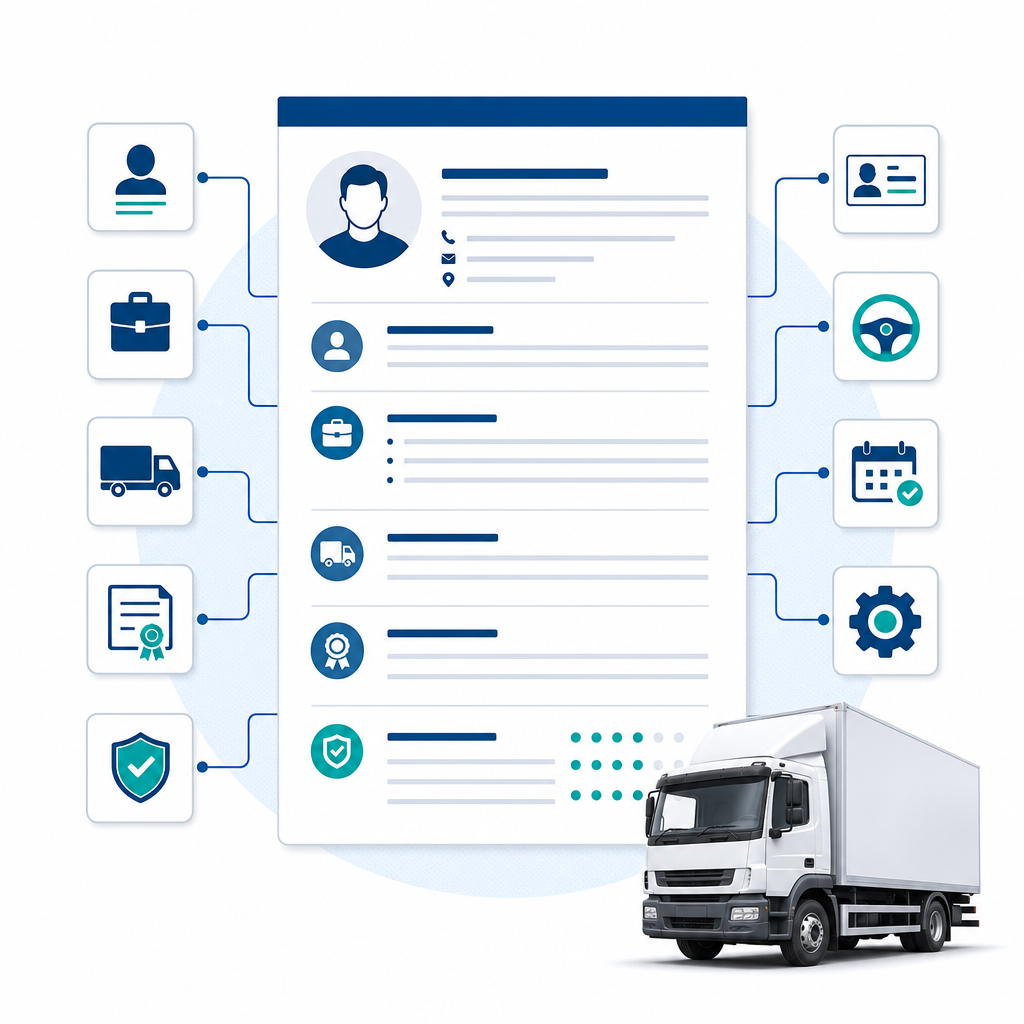
UK transport recruiters increasingly use ATS — Reed ATS, Workday and Greenhouse are the three you'll meet most often. They scan for licence categories, CPC validity, tacho card number and digi-card expiry. Here's a structure that consistently scores above 80 on the SpeedCV ATS checker:
1. Header (no photo)
Under the Equality Act 2010, UK CVs should not include a photograph, date of birth or marital status. Include name, mobile, professional email, and town + postcode area (not full address).
2. Licence and compliance summary
This is the section ATS keywords actually live in. Lead with it:
Licences: Category C+E (Class 1) since 03/2019 | Category C since 11/2017
Driver CPC: valid until 14/09/2027 (DQC held)
Digital tachograph card: expires 22/11/2029
ADR: Packages & Tanks (Classes 2, 3, 5, 6, 8, 9) — valid until 06/2028
Moffett / Hiab: certified 2023
Licence endorsements: clean
3. Professional profile (3–4 lines)
Plain English, active voice, no fluff. Example: "Class 1 driver with 6 years' multi-drop and trunking experience across DHL and Wincanton contracts. Clean licence, full ADR, consistent on-time delivery record of 98%+. Currently seeking a Monday–Friday day-trunking role in the West Midlands."
4. Driving experience (reverse-chronological)
For each role include: employer, dates DD/MM/YYYY, vehicle type, route type (trunking / multi-drop / store), typical daily mileage, and one or two quantified achievements (e.g. "Reduced cardholder infringements to zero across 18-month period").
5. Training and qualifications
List the 35-hour Periodic CPC modules completed in the last 5 years. Recruiters genuinely check this.
6. References — "Available on request"
Use a clean, sector-appropriate layout. SpeedCV's Forge template (designed for trades and construction roles) and the legacy UK Professional template are both free and tested for transport ATS — browse the full set at SpeedCV templates. If you want full hands-on help drafting the CV and tailoring covering letters, the CV writing London service is available from £149.
For a side-by-side look at how SpeedCV compares to better-known platforms for this kind of vocational CV, see SpeedCV vs Resume.io.
Interview and assessment day: what to expect
HGV interviews are typically split across two stages. Stage 1 is a competency-based phone screen or short Teams interview covering tacho rules, drivers' hours regulations (EU/GB and Working Time Directive), and incident handling. Stage 2 is on-site and usually includes:
- Vehicle familiarisation and drive assessment — 30 to 60 minutes with a transport manager or driver trainer, on a Class 1 or Class 2 unit relevant to the role.
- Reversing and coupling/uncoupling demonstration — particularly for trunking and yard-shunter positions.
- Walk-around vehicle check — DVSA-style daily check, naming components.
- Final interview — culture fit, shift pattern preferences, criminal record disclosure (drink/drive convictions are typically deal-breakers).
Common interview questions to prepare for:
- "Walk me through your daily walk-around check."
- "You're 30 minutes from your destination and your tacho says you have 25 minutes of driving time left. What do you do?"
- "How do you handle a customer site that refuses to unload you within your delivery window?"
- "Describe a time you had to refuse a load. Why?"
STAR-format answers (Situation, Task, Action, Result) work well here. Keep examples grounded in real route names, real customers and real outcomes — transport managers can spot fabricated stories within seconds.
Driver welfare and mental health resources
Long hours, isolation in the cab, sleeper-cab nights away from home and the demographic profile of UK drivers (predominantly male, average age over 50) combine to make mental health a real industry issue. The CIPD and Logistics UK have both highlighted welfare as a retention priority. Useful resources for UK HGV drivers in 2026:
- Mikey's Wish Foundation — driver-focused mental health support, founded after the loss of a young UK trucker; offers a confidential helpline and online community.
- DocBike — primarily known for roadside trauma care, also active in commercial-driver wellbeing campaigns.
- The Road Haulage Association (RHA) Benevolent Fund — financial and welfare assistance for drivers and their families during illness or hardship.
- Mind — the UK national mental health charity offers free, confidential advice on 0300 123 3393 and dedicated workplace resources.
- Samaritans — 116 123, free 24/7, including for drivers using motorway service areas.
Practical workplace levers also matter: choose operators that publish a Driver Welfare Charter (Tesco, John Lewis, DHL all do), prioritise depots with proper rest facilities, and avoid back-to-back fortnights tramping if it affects your sleep or mood.
Frequently asked questions
What's the difference between LGV and HGV?
None, in practice. LGV (large goods vehicle) is the modern DVLA/EU term; HGV (heavy goods vehicle) is the older British term. Both refer to heavy rigid jobs and articulated work in vehicles over 3.5 tonnes used for commercial transport. UK job boards use HGV more often, while DVLA paperwork uses LGV. They are interchangeable in 2026.
How long does it take to get a HGV licence in the UK?
From provisional application to a full Driver Qualification Card, expect 8 to 14 weeks. The medical (D4) takes a week, theory tests can be booked within 2 to 3 weeks, and intensive practical training is typically completed in 5 working days. Skills Bootcamps in Logistics compress this further with funded full-time training.
Are HGV jobs still in demand in 2026?
Yes. While the acute shortage of 2021 has eased, the Logistics UK "Skills and Employment Report" continues to show structural vacancies, particularly in Class 1 trunking, ADR-tanker work and refrigerated transport. Demographics — an average UK HGV driver age above 50 — guarantee ongoing demand throughout the late 2020s.
What is the average HGV driver salary in the UK?
In 2026, Class 2 drivers typically earn £30,000 to £38,000 and Class 1 drivers £38,000 to £52,000, before overtime and night-out allowances. ADR tanker specialists often clear £55,000. London and South-East roles attract a £2,000 to £3,500 weighting. ONS data for SOC 8211 confirms these ranges.
Can I become an HGV driver with no experience?
Yes. Major employers including Tesco, DHL, GXO and the British Army's Royal Logistic Corps run paid trainee schemes that take candidates from no licence to fully qualified Class 1 driver in 12 to 18 months. The 2023–24 Apprenticeship Levy reforms have expanded these routes, and DfE Skills Bootcamps in Logistics offer funded training for adults aged 19+.
Do HGV drivers need to be home every night?
It depends on the role. Multi-drop store delivery and refuse work are usually home-every-night. Class 1 trunking often involves 2 to 4 nights out per week, compensated with the HMRC-approved £26.20 nightly subsistence allowance plus a sleeper-cab. Filter your job search by "home daily" or "tramping" to match your lifestyle.
Is agency or PAYE better paid for HGV drivers?
Agency hourly rates look higher (£17–£22/hr Class 1 vs £16–£21/hr equivalent direct PAYE), but umbrella deductions and lack of pension, sick pay and bonus mean direct PAYE with operators like Tesco or DHL usually wins on total annual package. Agency suits flexibility seekers and seasonal peak workers; direct PAYE suits long-term career stability.
Can HGV drivers claim the £26.20 overnight allowance?
Yes — but it's paid by your employer, not claimed back from HMRC personally. Under HMRC EIM66205, employers can pay a tax-free £26.20 per night to drivers using a sleeper cab to cover meals and incidentals, without receipts, subject to an approved scheme. Always check whether a job advert quotes this in addition to basic pay.
Will electric and autonomous HGVs affect job security?
Electric tractor units are being deployed by Tesco, DHL and Pepsico but require the same Category C+E licence and trained drivers. Autonomous long-haul technology remains a 2030s+ prospect for UK motorways. Driver demand is expected to remain strong through the end of this decade.
Ready to start applying?
Build a CV that passes ATS on the first try, tailor it to each Reed or Workday application, and run it through a free ATS check before submitting. SpeedCV gives you 5 AI actions per day on the free plan, or unlimited tailored versions from £1.99 for a 14-day pass — see SpeedCV pricing. Create a free account and have your HGV driver CV ready within the hour.
Put these tips into practice
Create a professional, ATS-optimised CV in minutes with our AI-powered tool.
Build my CV — freeRelated articles
Keep reading with these guides
Cover letter for care assistant: UK template (2026)
Land your care assistant role: free UK cover letter template, NHS Band 2/3 pay context, 6 real examples and ATS tips that beat 87% of applicants.
Read articleCV writing London: 2026 costs, top services & insider tips
CV writing London costs £75–£600 in 2026. Compare CPRW-certified writers, ATS tactics for Workday/Greenhouse and insider tips for City, NHS & Civil Service.
Read article