CV examples UK: graduate, mid-career & senior (2026)
3 full UK CV examples by career stage + sector tweaks (NHS, Civil Service, finance, tech). ATS-tested for Workday, Greenhouse and Reed. Updated 2026.
On this page

UK recruiters spend an average of 6 to 8 seconds on the first scan of a CV (CIPD Resourcing & Talent Planning Survey). That is your entire window to prove you are worth a longer look. Whether you are a 2026 graduate writing a first CV examples UK template from scratch, a mid-career professional pivoting industries, or a senior leader competing for board-level roles, the structure that wins is radically different at each stage. This guide breaks down three full UK CV examples by experience level, with sector-specific variations, ATS guidance for systems like Workday and Reed ATS, and the conventions you must follow to comply with the Equality Act 2010.
Table of contents
- What are CV examples UK?
- UK CV rules that apply at every level
- Graduate CV example (0–2 years)
- Mid-career CV example (3–10 years)
- Senior CV example (10+ years)
- Sector adaptations: NHS, Civil Service, finance, tech
- How to pass UK ATS systems
- LinkedIn URL and salary expectations
- GDPR and sharing your CV with agencies
- Pairing your CV with a covering letter
- 10 mistakes that get UK CVs binned
- Frequently asked questions
What are CV examples UK?
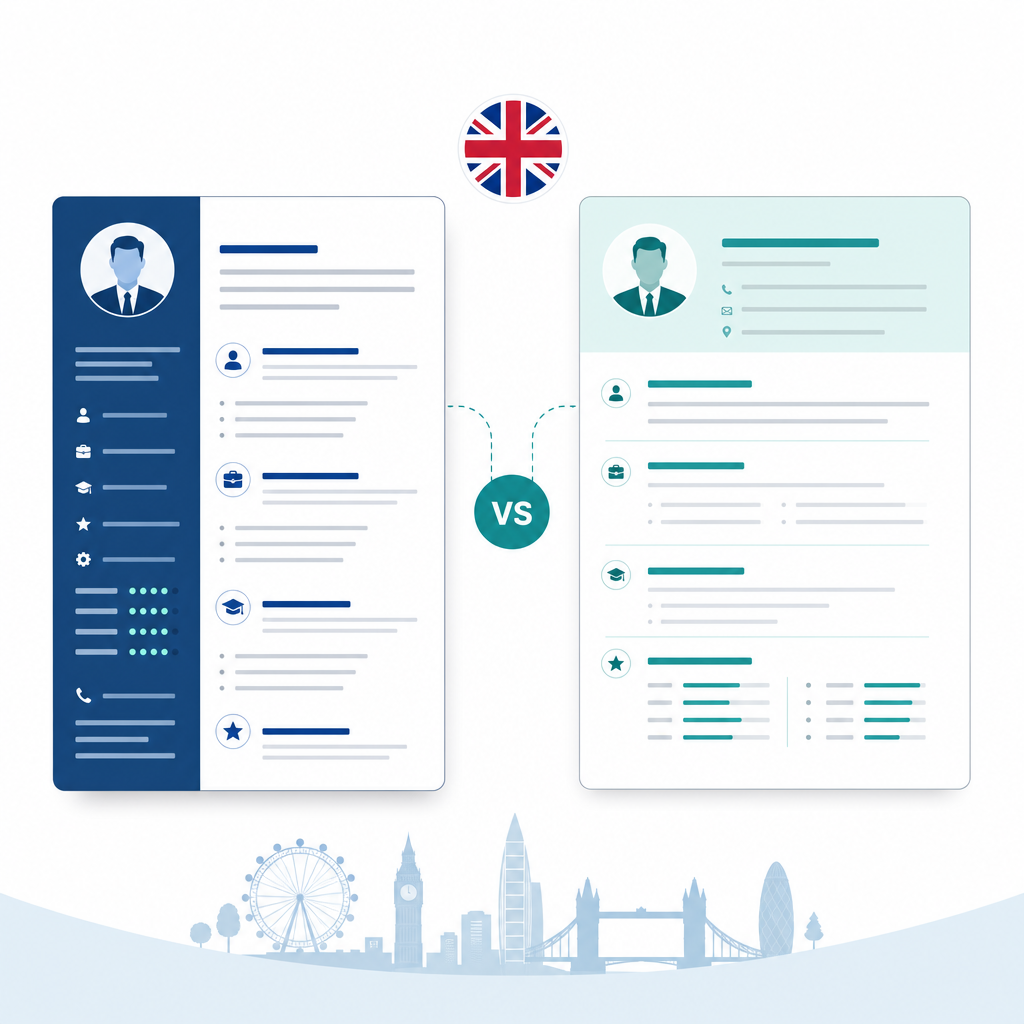
CV examples UK are template documents that follow British recruitment conventions: two pages maximum, reverse-chronological order, no photo, no date of birth, and no marital status. They differ from US resumes (typically one page, often with a summary at the top) and Continental European CVs (which may include a photo). A good UK CV example demonstrates achievements with measurable outcomes, uses British English spellings, and is structured for both human readers and applicant tracking systems used by Reed, Totaljobs and most NHS trusts.
UK CV rules that apply at every level
Before we look at the three experience-level examples, every UK CV in 2026 must follow these conventions. They apply equally to an 18-year-old applying for a Tesco Christmas temp role and a Chief Operating Officer applying to a FTSE 100 company.
- Length: Maximum 2 pages of A4. Graduates can stay on 1 page if light on experience.
- No photo: The Equality Act 2010 makes age, gender and ethnicity discrimination unlawful. Recruiters routinely discard CVs with photos to protect themselves.
- No personal data: Omit date of birth, marital status, nationality (unless visa status is genuinely relevant) and full home address. City and postcode area suffice.
- Date format: DD/MM/YYYY (e.g. 15/09/2026), or month abbreviation + year (Sep 2026).
- Spelling: British English throughout — write organise, analyse, optimise, programme, centre and colour, never the US variants ending in -ize or -yze or dropping the u.
- References: "Available on request" or omit entirely. Never list referee contact details upfront.
- File format: PDF unless the job advert specifies .docx (some NHS and Civil Service portals require Word).
If you want to check your existing CV against these rules before you read on, our free ATS checker will flag any compliance issues in under 30 seconds.
Right to Work and visa status
You are not legally required to state your nationality on a UK CV, and doing so can invite unconscious bias. However, if you hold a visa that affects sponsorship requirements (Skilled Worker, Graduate, Health and Care Worker visas), a single neutral line near the end of your CV — "Right to work in the UK: yes, no sponsorship required" or "Skilled Worker visa, valid until 2028" — saves recruiters a sensitive phone call and signals professionalism. If you do not need sponsorship, say so explicitly. UK Visas and Immigration confirms that employers must verify right to work, and pre-empting that check shortens the hiring cycle.
Disability Confident scheme
If you are applying to a Disability Confident employer (over 20,000 UK organisations including the NHS, Civil Service and most major councils), you may be entitled to a guaranteed interview if you meet the minimum criteria. Flag this by adding a brief line under your personal profile: "I am applying under the Disability Confident scheme and meet the essential criteria for this role." You do not need to disclose the nature of the disability on your CV — that conversation happens at interview if and when you choose. The scheme is set out at gov.uk/disability-confident.
Graduate CV example (0–2 years)
Graduate CVs are skills-led, not experience-led. With limited paid work history, you lead with education, projects, internships and transferable skills from part-time work or extracurriculars. Target length: 1 page, occasionally spilling to 1.5.
Graduate CV structure
- Header: Name (18pt), city/postcode, email, mobile, LinkedIn URL. No photo.
- Personal profile: 3–4 lines, 60–80 words. State degree, target role, one standout achievement.
- Education: Degree, university, classification (Predicted 2:1 / Achieved First), key modules, dissertation title if relevant. A-levels with grades. GCSEs summarised (e.g. "9 GCSEs grades 9–6 including English and Mathematics").
- Work experience: Part-time, internships, work placements. Include societies and volunteering with significant responsibility.
- Skills: Technical (Python, Excel, SPSS), languages with CEFR level, certifications.
- Interests: Optional, 1 line. Only if genuinely distinctive.
Real graduate CV example: NHS Foundation Programme applicant
Personal profile: Final-year Medicine student at University of Manchester (predicted MBChB, Distinction in clinical placement). Completed F1-shadowing rotations across General Medicine, Paediatrics and A&E at Manchester Royal Infirmary. Published co-author on one BMJ Open case report. Applying to North West Foundation School, UoA1.
Education: MBChB Medicine, University of Manchester (2021–2026, predicted Distinction)
Clinical experience: Healthcare Assistant, Salford Royal NHS Foundation Trust (Jun 2023 – Sep 2023): supported 24-bed acute ward, completed observations on average 18 patients per shift, contributed to discharge planning meetings.
For graduate schemes at the Big 4 (PwC, Deloitte, EY, KPMG) or Civil Service Fast Stream, lead instead with quantified achievements from internships and society leadership roles. A treasurer of a 400-member society who restructured the budget and saved £4,200 has a stronger CV than a student listing five vague "team player" bullet points.
Mid-career CV example (3–10 years)
Mid-career CVs flip the structure: experience leads, education shrinks. Two pages is standard. The personal profile becomes a value proposition aimed at the target role, not a generic summary.
Mid-career structure
- Header (same as graduate)
- Professional profile: 4–5 lines tailored to the job advert. Mirror keywords from the spec.
- Key skills / core competencies: 6–9 bullet points, ATS-friendly nouns (Stakeholder management, P&L responsibility, Agile/Scrum).
- Professional experience: Reverse-chronological. For each role: company, job title, dates (Sep 2021 – Present), 4–6 achievement bullets using STAR (Situation-Task-Action-Result).
- Education: Degree(s) and classification, single line each.
- Certifications: PRINCE2, AAT, CIPD, CFA Level 2, etc.
Real mid-career CV example: Marketing Manager pivoting to Product
Professional profile: Marketing manager with 7 years' experience at SaaS scale-ups (Series A–C) seeking to transition into Senior Product Manager roles. Owned the go-to-market launch of three B2B products with combined £4.2M ARR. Certified Product Owner (CSPO, Scrum Alliance, 2024).
Key skills: Product discovery · Quantitative user research · Jira · Mixpanel · A/B testing · Stakeholder management · Roadmap prioritisation (RICE) · OKR setting
Senior Marketing Manager, Acme SaaS Ltd (Mar 2022 – Present)
· Led cross-functional team of 6 (Engineering, Design, Sales) to launch Tier 2 product, achieving £1.4M ARR within 12 months — 28% above target
· Reduced customer acquisition cost by 31% by introducing data-driven channel attribution model
· Promoted from Marketing Manager after 14 months
Career changers should also read our career change CV guide and consider using our Match tool to test how your CV scores against live UK Reed job adverts before applying.
Senior CV example (10+ years)
Senior and executive CVs can run to 2 pages — exceptionally 3 for Director or C-suite. The focus shifts from doing the work to setting strategy, building teams and delivering P&L results. Quantification is non-negotiable: revenue, headcount, budget, market share.
Senior structure
- Header
- Executive summary: 5–7 lines positioning you against the target role. Mention sector, scale (revenue/headcount), and 1–2 signature achievements.
- Core leadership competencies: Board reporting, M&A integration, ESG strategy, digital transformation, etc.
- Career history: Last 10–15 years in detail. Earlier roles condensed to a single line each ("Various commercial roles, Unilever, 2008–2014").
- Board / NED / advisory roles if applicable
- Education and qualifications: Postgraduate first (MBA, CIMA, FCA), then undergraduate.
Real senior CV example: Operations Director, manufacturing
Executive summary: Operations Director with 17 years' experience scaling UK manufacturing operations from £8M to £142M turnover. Led post-Brexit supply chain restructuring across three sites (Birmingham, Sheffield, Belfast), reducing landed cost by 11%. Chartered Engineer (IMechE) and Six Sigma Black Belt.
Operations Director, [FTSE 250 Industrials] (Jan 2019 – Present)
· P&L responsibility for £142M turnover division, 480 FTE across three UK sites
· Delivered £6.8M annualised savings via lean manufacturing programme (2022–2024)
· Sponsored the SAP S/4HANA implementation, on budget and 3 weeks ahead of schedule
Sector adaptations: NHS, Civil Service, finance, tech
Generic templates rarely win at sector-specific employers. Below are the key adaptations for the four sectors where UK CV conventions diverge most.
| Sector | Length | Critical sections | Application portal |
|---|---|---|---|
| NHS (Bands 5–8a) | 2 pages + supporting statement | NMC/HCPC PIN, mandatory training, clinical competencies mapped to person spec | NHS Jobs (TRAC) |
| Civil Service | CV + behaviour statements | 250-word behaviours (Leadership, Delivering at Pace, etc.) | Civil Service Jobs |
| Finance (City) | 2 pages | FCA SMCR status, deal sheet for IBD, exam progression (ACA/CFA) | Workday, eFinancialCareers |
| Tech | 2 pages + GitHub | Tech stack, open-source contributions, system design | Greenhouse, Lever, LinkedIn |
NHS applicants should pair their CV with sector-specific examples — see our NHS CV examples from Band 5 to Band 8a. Civil Service candidates need to master the behaviours framework: read our 9 winning Civil Service behaviours answers before submitting.
How to pass UK ATS systems
The majority of large UK employers screen CVs through an applicant tracking system before a human sees them (Jobscan ATS research). The dominant systems are Workday (used by most FTSE 100 corporates), Greenhouse (tech and scale-ups), Reed ATS (Reed.co.uk applications), and TRAC (NHS).
ATS-friendly formatting checklist
- Use a single-column layout. Two-column designs scramble parsing on Workday and Greenhouse.
- Standard fonts: Arial, Calibri, Garamond, Helvetica. Avoid Comic Sans, decorative scripts.
- No text inside images, headers or footers — most ATS skip these zones.
- Use standard section headings: "Work experience" not "My journey".
- Submit PDF unless instructed otherwise. Modern ATS parse PDF reliably.
- Match keyword phrasing from the job advert. If the advert says "line management", do not write "people leadership".
Run your CV through our ATS checker to see your score and the exact keywords you are missing. All 21 SpeedCV UK templates are ATS-tested against Workday, Greenhouse and Reed ATS.
LinkedIn URL and salary expectations
Two small details handled badly can sink an otherwise strong UK CV: your LinkedIn link and the question of salary. Here is the convention in 2026.
LinkedIn URL as a CV companion
A LinkedIn URL is now expected in the header of every UK CV from graduate to executive level. Before you paste it in, do three things: customise the vanity URL (linkedin.com/in/firstname-surname rather than the default string of numbers); ensure the headline, current role and "About" section match the dates and titles on your CV exactly; and switch on "Open to work" privately (visible to recruiters only) if you are job hunting confidentially. UK recruiters at Reed, TotalJobs and Hays will cross-check your CV against your profile within minutes of receiving it, and any discrepancy — a date that does not match, a title that has been embellished — is the fastest way to be excluded from the shortlist.
Salary expectations: omit unless asked
UK convention is to leave salary off the CV entirely. The covering letter is the place to address it, and only if the advert explicitly requests current salary or expectations. Stating a number on the CV itself either prices you out of roles where the budget is flexible or anchors you below what the employer was prepared to pay. If a recruiter asks during a screening call, give a range based on ONS earnings data for your role and region rather than a single figure. For most professional roles a 15 to 20 per cent band (e.g. "£52,000 to £62,000") leaves room to negotiate without seeming evasive.
GDPR and sharing your CV with agencies
Under the UK GDPR and the Data Protection Act 2018, your CV is personal data. When you send it to a recruitment agency, that agency becomes a data controller and must:
- Tell you who they are and what they will do with your CV (their privacy notice).
- Ask for explicit consent before forwarding your CV to any third party, including the end client.
- Retain your data only for as long as necessary — typically 6 to 12 months for active candidates.
- Delete your data on request (right to erasure under Article 17).
Practical implications for your CV itself: omit your full address (city + first half of postcode is plenty), use a dedicated email address if you are job hunting confidentially, and never include your National Insurance number, passport number or bank details. If an agency uploads your CV to a public job board without consent, you can complain to the Information Commissioner's Office (ICO). The ICO has fined UK recruitment firms for unlawful data sharing in the past, so reputable agencies take consent seriously.
Pairing your CV with a covering letter
In the UK, a covering letter remains expected for most professional applications, even when the advert says it is optional. Where the CV documents what you have done, the covering letter explains why you are applying for this specific role at this specific organisation. Keep it to a single page of A4, three or four short paragraphs:
- Opening — the role you are applying for and where you saw it.
- Why you — two or three achievements from your CV that map directly to the person specification.
- Why them — one or two sentences showing you understand the organisation's mission, recent news or strategy.
- Close — confirmation of availability for interview and notice period.
For full templates by sector, see our 15 UK cover letter examples and the broader cover letter sample guide. SpeedCV bundles 8 premium cover letter templates with every paid plan.
10 mistakes that get UK CVs binned
- Including a photo (Equality Act risk for the employer)
- American spellings — UK CVs must use British forms (organise, optimise, analyse, colour, centre, programme) and avoid the US -ize, -yze and -or equivalents. UK recruiters read these as a sign you have used a US template without checking.
- Listing duties instead of achievements ("Responsible for sales" vs "Grew territory revenue 34% to £2.1M")
- Exceeding 2 pages without justification
- Generic personal profile not tailored to the role
- Date gaps with no explanation (maternity, illness, sabbatical, redundancy — name them briefly)
- Unprofessional email ([email protected])
- References listed in full on the CV itself
- Decorative graphics that confuse ATS parsers
- Spelling and grammar errors — repeatedly flagged in CV-Library recruiter research as a leading cause of CV rejection.
Free UK CV templates
SpeedCV offers 21 active UK CV templates including the most-used uk-professional template (Free), plus sector-specific designs: Sage for NHS nurses and care workers, Forge for trades and construction, Crimson for office management, Voltage for tech and audio engineers, Claret for hospitality, and Pulse for sales. Start free, upgrade to the 14-day pass for £1.99 for unlimited AI generation and PDF exports without watermark.
If you would prefer a human writer to handle the rewrite, our London CV writing service is delivered by CPRW-certified writers from £149.
Frequently asked questions
How long should a UK CV be?
Two pages of A4 is the UK standard for almost every role. Graduates with limited experience can use a single page. Senior executives applying for board or C-suite roles can occasionally extend to three pages if they have substantial board, NED or international experience to document. Anything longer should be a LinkedIn profile or a separate biography.
Should I include a photo on my UK CV?
No. Including a photo on a UK CV is strongly discouraged. The Equality Act 2010 protects candidates from discrimination based on age, gender, ethnicity, religion and disability. Many UK employers and recruitment agencies will discard CVs with photos to reduce their legal exposure. The only exceptions are acting, modelling and some front-of-house hospitality roles where appearance is a bona fide occupational requirement.
What is the best CV format for the UK in 2026?
Reverse-chronological is the strongest format for the UK in 2026. Recruiters and ATS systems both parse it most reliably. It places your most recent role first, which is what 90% of UK hiring managers look for. Functional (skills-based) CVs are now viewed with suspicion because they often disguise gaps. A hybrid format — short skills block followed by reverse-chronological experience — works well for career changers.
How do I write a CV with no work experience?
Lead with your education, including modules, projects, dissertation and any prizes. Add a "Projects" section for coursework, hackathons, or self-directed learning (especially valuable in tech). Include volunteering, part-time work, society roles, sports captaincies, and Duke of Edinburgh awards. Frame each entry using the STAR method (Situation, Task, Action, Result) to demonstrate transferable skills. A 1-page CV is acceptable at this stage.
What is the difference between a CV and a resume?
In the UK, "CV" (curriculum vitae) is the standard 2-page document used for all job applications. In the US, a one-page summary document is the norm for most jobs, while "CV" refers to a longer academic document. If you are applying to a UK role, always submit a CV in British format regardless of which term the advert uses. UK conventions trump American terminology.
Should I put salary expectations on my UK CV?
No. UK convention is to leave salary expectations off the CV. Address them in the covering letter only if the advert explicitly requests current salary or expectations, and give a 15 to 20 per cent band rather than a single figure. Stating a number on the CV itself either anchors you too low or prices you out of negotiations. ONS earnings data for your role and region is the strongest benchmark for any range you quote.
How do I tailor my CV for each job application?
Read the job advert and person specification line by line. Identify the 8–10 keywords that appear most frequently and weave them into your personal profile, key skills, and achievement bullets — provided they are genuinely accurate. Re-order your bullets so the most relevant achievements appear first under each role. Update your personal profile to mirror the language of the advert. Tools like SpeedCV's Match feature compare your CV against the live job advert and suggest changes in seconds.
Do UK recruiters prefer PDF or Word CVs?
PDF for most applications, because it locks formatting across devices and ATS systems. The exception is NHS TRAC, some Civil Service portals, and certain agency websites that explicitly request .docx so they can edit the document before forwarding to the client. Always check the application instructions. If unclear, PDF is the safer default in 2026.
Put these tips into practice
Create a professional, ATS-optimised CV in minutes with our AI-powered tool.
Build my CV — freeRelated articles
Keep reading with these guides
Cover letter sample: 5 UK examples that won interviews
5 UK cover letter samples — NHS, Civil Service, retail, hospitality, Big 4 finance. ATS-tested, free to copy (2026).
Read articleCV writing London: 2026 costs, top services & insider tips
CV writing London costs £75–£600 in 2026. Compare CPRW-certified writers, ATS tactics for Workday/Greenhouse and insider tips for City, NHS & Civil Service.
Read article